// welcome
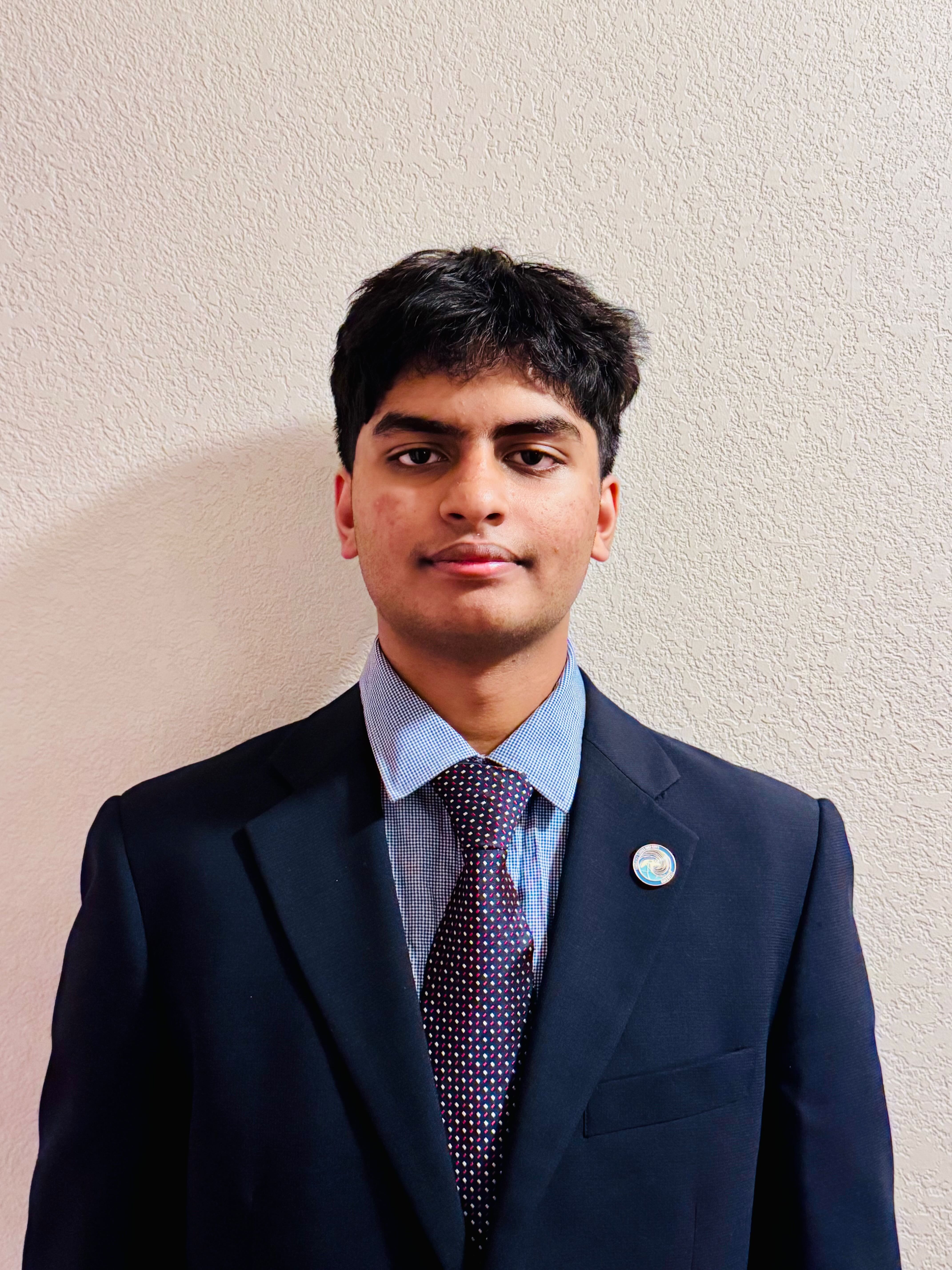
Hi, I'm Adi.
I'm a senior at Pacific Collegiate School in Santa Cruz, and I'm happiest when I'm building something that works. Robots, sensors, and AI models are my tools, and doing something meaningful for the world around me is the reason. When a build fails or a team hits a snag, I'm usually the one who stays calm and keeps working the problem. Here's how I got here.
The Breakthrough
This was the year the things I'd been building finally came together. As VP of ROV Engineering, I led a group of three coders and helped our team win 1st place at the MATE ROV World Championship in Newfoundland & Labrador, Canada, among 47 teams from 15 countries. Closer to home, the wildfire robot I poured myself into earned Best in Show, Senior Division at the county science fair and a First Award of $500 at ISEF from the Patent and Trademark Office Society. With Fireguard - the autonomous wildfire detection and suppression system I co-founded with my sister Aria - I was named a Distinguished Conrad Innovator in The Conrad Challenge. The awards are nice, but what I care about is that the things I build might one day protect people and places like the ones I grew up around.
I also spent the summer at Stanford University, completing CS106EA: Exploring Artificial Intelligence - building a real foundation in machine learning pipelines, neural networks, and generative AI that's shaping what I want to build next. All awards → · Press coverage →
None of it happened overnight, though. To understand how I got here, I have to go back to where it actually started.
The Spark
In 2020, the CZU Complex Fires came close enough to force my family out of our home for nearly three months. Watching what that did to our neighbors and our community stuck with me - and it's the reason wildfire prevention has stayed at the center of my work ever since.
On the engineering side, it started with drones. In 2022, as a middle schooler, I built my first real engineering project - Flying High with Drones - and entered it in the Santa Cruz County Science Fair. I placed 1st in Physics. The following year I built Ultrasonic Eyes, testing how accurately an HC-SR04 ultrasonic sensor could detect obstacles under different temperatures and materials. That one won 1st place in Physics again, plus an award from IEEE.
Those two projects taught me the thing that's stuck with me since: I don't really understand an idea until I've built a version of it that can fail in front of a judge. That hunger to prove an idea in the real world only grew from here. See all projects →
Building & Learning
This is the stretch where things got harder, and more interesting. I joined X Academy Hephaestus Robotics and started competing in the MATE ROV Competition - first as a Circuit Designer on the Navigator team (Angry Otters), which placed 2nd in Northern California in 2024, then moving to Ranger as Electrical Engineer/Circuit Designer, custom-designing the PCBs for the ROV's internal electronics. That Ranger team won the Northern California Regional in 2025 and took 3rd at the MATE ROV World Championship in Michigan.
On the science side, I moved from pure physics into sensors and code: Towards Sensor Fusion (2024) combined LiDAR, ultrasonic, and infrared sensor data to precisely locate objects, and in 2025 I built a project comparing CNN architectures for self-driving car safety - ResNet-50 hit 77% accuracy classifying road signs, against 23% for VGG-16. That project also won 1st place in Computer Science at the county fair, plus a Genius Olympiad award. That same summer I worked as a software intern at Karr Company, coding in Java and React on an AI-powered platform that simplifies vehicle administration, and a summer earlier I volunteered with YouthServe on environmental clean-ups around Santa Cruz. That groundwork is what made this year's breakthrough possible - and the story doesn't stop there. Full robotics history →
What's Next
Which brings me back to now. This year I'm building an autonomous wildfire suppression robot - a prototype with an embedded sensor fusion framework built on YOLOv8 object recognition that detects fire and activates suppression on its own in rough terrain. I engineered heat-resistant shielding to keep the system running within active flame zones, and I consulted San Jose Battalion Chief Robert Culbertson to understand real-world firefighting requirements along the way.
I'm also taking Math 207: Linear Algebra through the University of North Dakota for undergraduate credit, alongside a senior-year course load of AP English Literature, AP Physics C (E&M), AP Microeconomics, AP Statistics, and Topics in Design & Engineering. Read the full project write-up →
A lifelong curiosity about anything that moves
Cars, drones, and machines in general have fascinated me for as long as I can remember. When I was 10, I downloaded Mega Machines by Paul Harrison on my Kindle, expecting a simple kids' book about sports cars - instead I found detailed specs on some of the most advanced machines of the time, and I was hooked on the engineering behind them. I've been going to Maker Faire Bay Area for years to watch drone racing and see what other people are building, and I'm lucky enough to live close to Monterey Car Week, where I've seen some genuinely rare hypercars in person. Anything that moves, I want to understand how.
Tenacity in learning cutting-edge topics
When Tesla moved from radar and ultrasonic sensors to camera-only collision detection in 2023, I decided to build my own image-detection AI model with no prior experience in the field. I hit plenty of obstacles and failures along the way, but I was having too much fun learning to train and deploy models to let that discourage me. Those early failures turned out to be the foundation for several AI systems I've built since.
A relentless passion for robots that help our ecosystems
In 11th grade, I spent three months getting my firefighting robot to work, and another two improving it to make it as effective as possible. I put in countless late nights on the hardware and software - to the point that I had the Raspberry Pi's reboot sound memorized for weeks afterward. It was hard, and I gave up a lot of sleep for it, but the satisfaction of finally getting it right made all of it worth it.
The hardest stretch came after weeks of sleepless nights modifying a Pi HAT for the robot, to no avail. I was on the verge of giving up, but I pushed myself to stay focused, stepped away, and took a walk in the cold night. Cooling down both physically and mentally, I thought over every piece of the robot I had double-checked, and it dawned on me that the Pi HAT itself had escaped my radar. I took a leap of faith and ordered a new board, and I was delighted to find my whole system working. Failing over and over has taught me that getting agitated only creates more problems, and thinking analytically works far better.
Hands-on experimentation, even outside engineering
I've cooked since I was 12, when I finally earned my parents' trust to use the stove, and I've spent over four years experimenting with one dish in particular: avocado toast. It's an easy dish to get boring, so I kept testing combinations of sweetness, spice, tang, and texture to avoid the usual mushiness. After a lot of failed, genuinely unpleasant attempts, I landed on a version with honey-roasted peanut butter for sweetness, roasted chilies for heat, fried jalapeño bits for crunch, and a fried egg for richness and color.